A gadgets high-recurrence execution depends vigorously on the electrical properties of the PCB utilized for mounting and associating its circuit parts.
The degree of the PCB configuration impact heightens dramatically with an increment in functional recurrence.
The overlay materials for making high-recurrence sheets have explicit elements, similar to dielectric steady (Dk), misfortune digression (r), and coefficient of warm extension (CTE).
High-recurrence overlays utilize further developed composites contrasted with standard FR-4 materials.
Lets research the different high-recurrence necessities, for example, PCB cover materials, follow width and dividing, arrangement of planes, part interconnections, and creation issues with special materials that originators and producers ought to consider.
The developing intricacy of gadgets regularly calls for quicker signal transmission rates, subsequently, higher transmission frequencies.
They commonly convey signals recurrence scope of around 7 GHz, making it reasonable for rapid computerized plans, radio recurrence (RF), microwave, and cell phone use cases.
Another important thing about high-frequency PCBs is that they require unique materials a slight change in the (r worth of the base materials can altogether influence the PCB impedance.
Most originators and makers use the Rogers dielectric materials since they have insignificant dielectric and sign forfeiture, less circuit creation expenses, and they function admirably in fast turn prototyping applications.
The least difficult way of seeing high-recurrence sheets is by concentrating on their qualities. The following are four essential highlights of high-recurrence PCBs.
They have a more modest and stable Dielectric Constant (Dk) (goes from 2.1 to 5) to forestall delay in signal transmission.
The lower the Dk numerical quantity, the higher the recurrence transmission rate.
The dispersal factor (DF) is minute so as not to influence the sign transmission rate.
Along these lines, attempt to work with a DF of somewhere in the range of 0.0019 and 0.025 for quality sign transmission.
The sheets guarantee the warm development pace of the overlays is as old as of the copper foil.
This will forestall the partition of copper foil when there is a temperature variety.
High-recurrence PCBs guarantee suitable warm obstruction, sway perseverance, substance opposition, and strip off opposition.
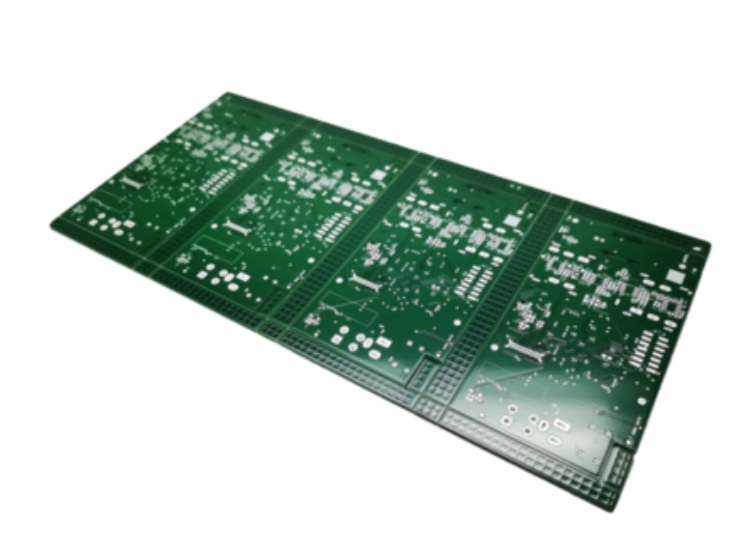
Scheming a PCB for ideal high-recurrence execution necessitates that you comprehend the impacts of load up cover materials, follow separating and width, arrangement of planes, part interconnections, and manufacture issues.
Lets investigate these plan boundaries.
You can utilize different materials to make high-recurrence circuits. However the essential materials are FR-4, you can utilize different materials that give solid electrical execution.
They incorporate low-misfortune RF materials like unadulterated polytetrafluoroethylene (PTFE), artistic filled PTFE, hydrocarbon fired, and high-temperature thermoplastic.
While FR-4 has its weaknesses when applied in high-recurrence circuits, you ought to recognize those hindrances and foster execution trade offs for your plan.
1. The stability of Dk which can change from one part to another and over recurrence.
2. Misfortune factor dependent on surface toxins and the hygroscopic idea of the overlays.
3. Capacity to suffer producing temperatures without lead fabricating temperatures are higher than standard patching temperatures.
4. Warm transmission Even low-power, high-recurrence PCBs produce heat.
While picking the reasonable PCB material for high frequencies, you should gauge the above boundaries against item cost.
The decision goes from practical FR-4 materials, with approximately controlled Dk esteems, to FR-4 materials with higher determinations and very much indicated dielectric consistent.
You ought to successfully put your ground planes, and the dielectric material to adjust the impedance transmission line.
To accomplish this, you want micro-strips, strip-lines, co-planar wave-guides, and differential sets.
Since high-recurrence signals are touchy to commotion, ringing, and reflections, you ought to painstakingly plan them for impedance.
The regular impedance is 50 for single-finished and 100 for differential transmission line, with control bounds of 10%.
In a strip-line, the circuit follow with the high-recurrence signals is directed on a sheets inner layer.
Contact us today for your high quality high frequency PCB with improved signal transmission and sp.