Seeing the board, the small green chips, the holes, and the golden lines, I’m sure you should be able to easily recognize a printed circuit board.
But wait, are those components on the board merely for decorations? No, they are not.
To have a full knowledge of PCB fabrication, you need to know the components involved together with their functions.
How is the printed circuit board fabricated? What are those components on the board? What are their functions? What…
Don’t worry, in this article, we will walk you through the major components of a printed circuit board.
Every printed circuit board has a resistor. It is a rectangular plate mounted on the board.
The resistor controls and regulates the amount of current that flows to the other parts of the printed circuit board.
Resistors are available in different colors. However, blue and tan colors are the most common.
The role of a capacitor is to store electric charges flowing through the printed circuit board.
Capacitors can have either a disc shape or a cylindrical shape.
Transistors are “D” shaped components on the printed circuit board. Their location is usually indicated by a “Q” symbol.
The function of transistors is to amplify electronic signals and increase the power flowing through the circuits on the printed circuit board.
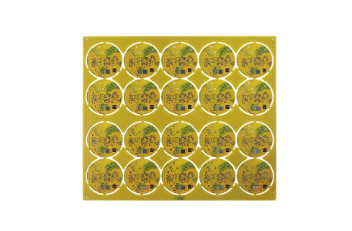
Light emitting diodes are mounted on PCB to give off light. Several colors of LEDs are available. LED can come in single color or multicolor.
The power of LED also varies and it can be low-powered or high-powered.
These components are indicated with symbol “L” on the printed circuit board. Inductors are difficult to identify. However, they occur as wired coils or color-coded coils on the printed circuit board.
The function of inductors is to convert electrical energy into magnetic energy and store the energy in that form.
Integrated Circuits are made from silicon. They are wafers that act as amplifiers, oscillators, timers, or memory on the printed circuit board.
A few other components such as transistors, resistors, and capacitors are held by the Integrated circuits.
Wires provide a means for the flow of electric current from one part of the printed circuit board to another.
They are essential components that allow electron transfer from one part to another.
The function of transformers is to step down the power supply to ensure that optimum power flows through the circuit on the printed circuit board.
A transformer usually has two coils known as the primary and secondary coils. These coils can either step-down or step-up voltage depending on the power of electricity supplied to the printed circuit board.
Do you want to get a PCB fabrication that suits your need? Maybe you’re worried about getting a reputable manufacturer.
Worry no more, we’ve got the solution you are looking for. Being a reputable manufacturer of printed circuit boards, you can get the best-fabricated PCB from us. Click here and get your PCB fabrication now!